
Criminal Court Records in Calhoun County
A criminal court record is the case file that opens once charges are filed against a person. The clerk of court builds it and keeps it. It holds every paper the court receives in that case. The indictment or charging paper, bond orders, motions, plea petitions, hearing notes, and the final judgment all land in one place. In Calhoun County, felony files sit with the Circuit Court. Carlton Baker, the Circuit Clerk, keeps those records at the courthouse in Pittsboro. The arrest and booking side stays with law enforcement. The court file tracks what the court does with the case after charges arrive.
Which court holds the file depends on the charge. The Circuit Court hears felony cases for Calhoun County and sits within the Third Circuit Court District. Justice Court handles county misdemeanors, traffic, and some early criminal steps. Municipal courts handle city crimes and ordinance cases. A felony often begins as an affidavit in a lower court, then moves up to Circuit Court once a grand jury returns an indictment. The booking side and the filed counts are a separate record. For a closer look at the charges as written, the Calhoun County arrest records and court charges page covers that ground.
How to Search Calhoun County Criminal Court Records
Calhoun County has no single public criminal case search box. Circuit Court files live in the Third Circuit Mississippi Electronic Courts (MEC) system. That system went live for the county on March 20, 2023. Access to filed documents and case detail runs through a MEC or PAMEC login, so there is no free anonymous case search from the public page. For older paper files, sealed matters, or certified copies, the Circuit Clerk is the direct route.
- Identify the right court first. Felony cases point to the Calhoun County Circuit Court, while county misdemeanors and traffic point to Justice Court or a municipal court.
- Open the Third Circuit MEC portal and sign in with MEC or PAMEC credentials to view docket entries and filed documents.
- Search by the defendant name or the case number once you are logged in, then narrow by case type and filing date.
- Open the case to read the docket, the charges, the plea, and the disposition entries.
- Call or visit the Circuit Clerk at 662-412-3101 for a certified copy, a pre-2023 file, or any record the portal will not show.
State systems hold criminal data too. Sentenced state prisoners appear in the Mississippi Department of Corrections inmate search, which is not the same as a county case file. A statewide public criminal history search was not found in official Calhoun sources, so the court file at the clerk remains the most complete local record.
Note: A docket may exist online while sealed, juvenile, or redacted documents inside it stay hidden, so a visible case still may not show every paper.
Stages of a Calhoun County Criminal Case
A felony case moves through the Circuit Court in clear steps, and the record grows at each one. The Mississippi Rules of Criminal Procedure set how charges, hearings, pleas, and judgments proceed. Reading the docket in order shows where a case stands. A new entry marks each event, from the first charge to the last order.
Case flow: Charges Filed › Arraignment › Pretrial / Motions › Plea or Trial › Disposition › Sentencing
| Stage | What Happens |
|---|---|
| Charges Filed | A grand jury returns an indictment, or the state files an information. The clerk opens the case file and assigns a number. |
| Arraignment | The defendant hears the charges in open court and enters a plea. The judge may set bond and address counsel. |
| Pretrial / Motions | Lawyers file motions, exchange evidence, and argue legal points. Many cases end with a plea at this stage. |
| Plea or Trial | The defendant pleads guilty or no contest, or a judge or jury decides guilt at trial. |
| Disposition | The court records the outcome of each count, such as convicted, dismissed, or acquitted. |
| Sentencing | After a guilty plea or verdict, the judge orders the punishment and the clerk files the sentencing order. |
What a Calhoun County Criminal Court Record Shows
A criminal case file is built from many fields, and each one tells part of the story. The clerk records names, dates, charges, and rulings as the case moves. MEC is the main digital home for Circuit Court records, though the public pages do not expose a free sample. Personal data is guarded. MEC rules warn that Social Security numbers, birth dates, names of minor children, financial account numbers, and home addresses should not appear except as the procedures allow.
| Field | What It Shows |
|---|---|
| Case Number | The unique number the clerk assigns when the file opens. It is the key to pull the docket. |
| Defendant | The person charged, listed by legal name. Co-defendants may share a case or have linked files. |
| Court and Judge | The court division and the judge assigned to hear the case. |
| Charges | Each count, the statute cited, and the offense level, such as felony or misdemeanor. |
| Bond | The amount and type of bond set for release, such as cash or surety. |
| Plea | How the defendant answered, such as guilty, not guilty, or no contest. |
| Docket Entries | A dated list of every filing, motion, hearing, and order in the case. |
| Disposition | The outcome of each charge, such as convicted, dismissed, or acquitted. |
| Sentence | The punishment after a conviction, such as prison, probation, fines, or restitution. |
Reading Calhoun County Criminal Sentences
The disposition is the part most readers want. It tells how a charge ended. One case can hold several counts, and each count can end a different way. A defendant might be convicted on one charge and cleared on another. The sentence then sets the penalty for any count that ended in guilt. Common terms appear again and again across Calhoun County criminal files.
- Guilty
- A plea or verdict that admits or finds the defendant committed the offense.
- Not guilty
- A plea that denies the charge, or a verdict that clears the defendant.
- Dismissed
- The court drops the charge. Dismissed with prejudice cannot be refiled; without prejudice may be refiled.
- Nolle prosequi
- The prosecutor chooses not to pursue the charge further.
- Nolo contendere
- A no-contest plea that accepts the penalty without admitting guilt.
- Probation and restitution
- A supervised sentence in the community, often paired with money paid to a victim.
A sentence line reads as a set of terms. It may list a prison or jail term, a probation period, fines, court costs, and restitution. Suspended time and credit for time served can change what a person actually serves. The full sentencing order in the file controls, so a one-line summary in a docket is only a starting point. To see how this record fits the wider set the courthouse keeps, the Calhoun County court records page maps every case type.
Note: A short docket label may not capture the full order, so always read the signed judgment or call the Circuit Clerk to confirm a sentence.
Charges vs. Convictions
A charge is not a conviction. Being charged only means the state has accused a person of a crime. A conviction means a court found guilt or accepted a guilty plea. A criminal court record can show charges that were later dropped, dismissed, reduced, or that ended in acquittal. Reading a file as if every charge equals guilt is a common and serious mistake.
| Charge | Conviction | |
|---|---|---|
| Stage | Accusation by the state | Verdict or accepted plea |
| Who Decides | Prosecutor or grand jury | Judge or jury |
| Burden of Proof | Probable cause | Beyond a reasonable doubt |
| Can It Change | Yes, may be dropped or reduced | Stands unless appealed or vacated |
| Public Record | Yes | Yes |
Important: A pending or dismissed charge in a Calhoun County file is not proof of guilt, and using it that way can be both unfair and unlawful.
Who Prosecutes and Defends Criminal Cases
Two sides drive a criminal case, and both leave marks in the record. The state brings the charge through a prosecutor. The defense answers through private counsel or an appointed public defender. In Calhoun County, felony prosecution runs through the Third Circuit District Attorney's Office, which serves Benton, Calhoun, Chickasaw, Lafayette, Marshall, Tippah, and Union counties. The office decides what to charge, what to offer in a plea, and what to take to trial.
The district attorney's role starts at the Third Circuit District Attorney homepage, which lists the seven counties the office covers.
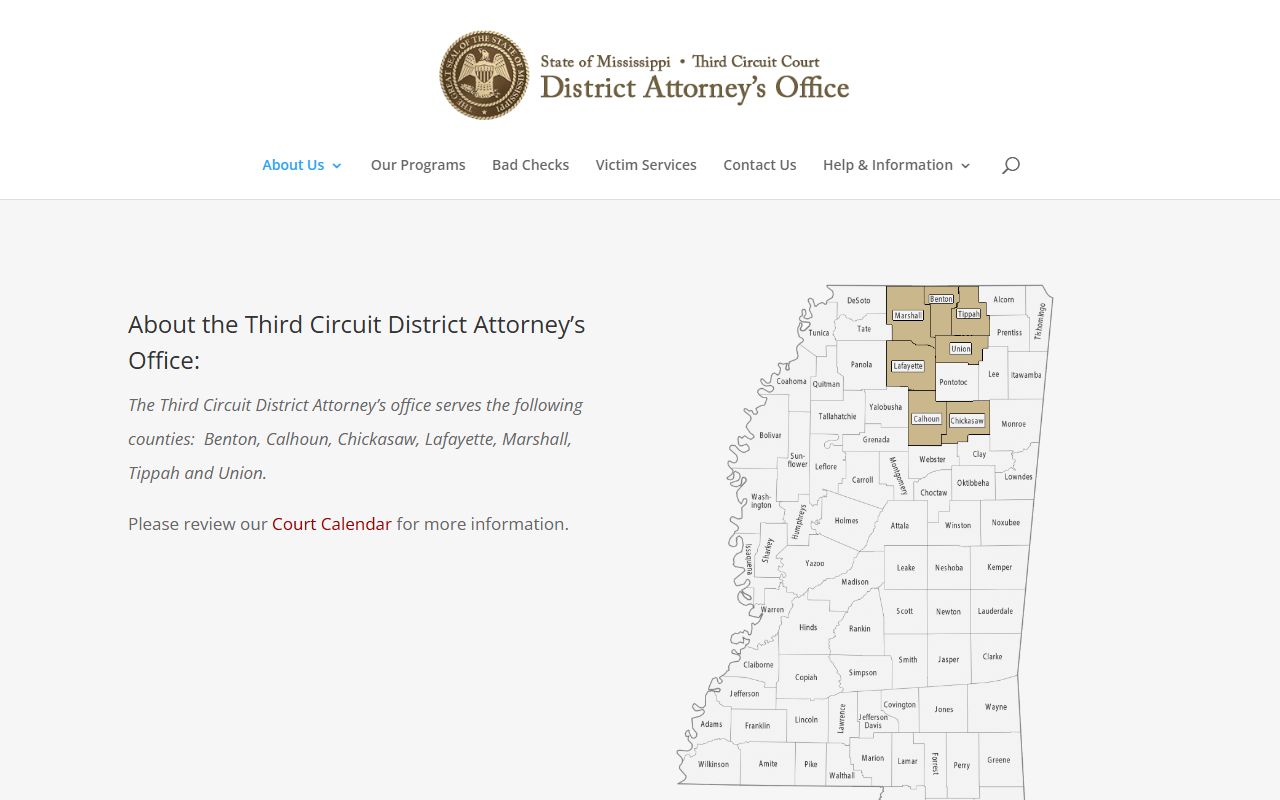
That homepage is the public front for the office that signs most felony charging decisions affecting Calhoun County defendants.
Ben Creekmore serves as the elected District Attorney for the district. Karsunn Moore is the Assistant District Attorney assigned to Calhoun and Chickasaw counties, and that assignment shapes who handles local felony files day to day. The office staff is listed on the DA attorney profiles page.
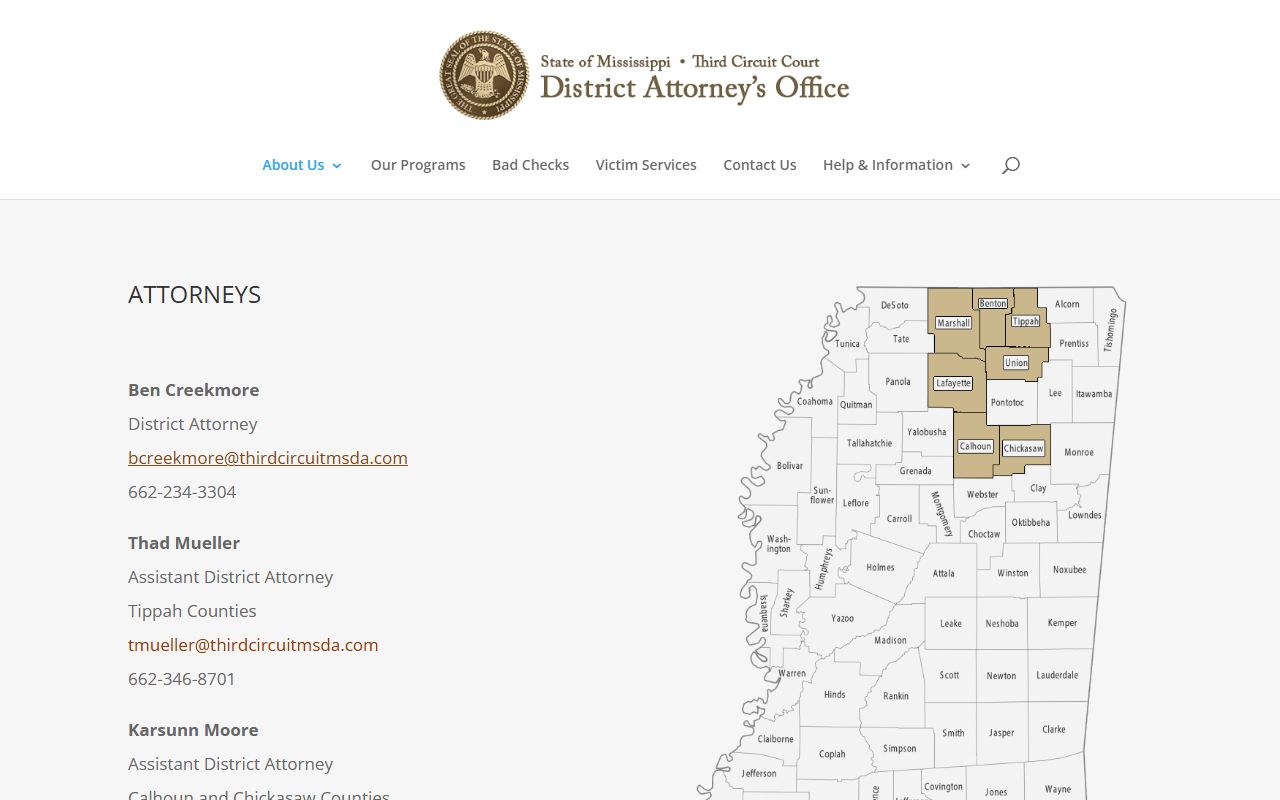
Knowing the assigned prosecutor helps a reader understand who pushed a charge through the case shown in the record.
For misdemeanor and lower-court matters, Calhoun County also has a County Prosecuting Attorney, Tina Dugard Scott, based in Calhoun City. The district attorney office in New Albany lists its phone numbers and address on the DA contact page.
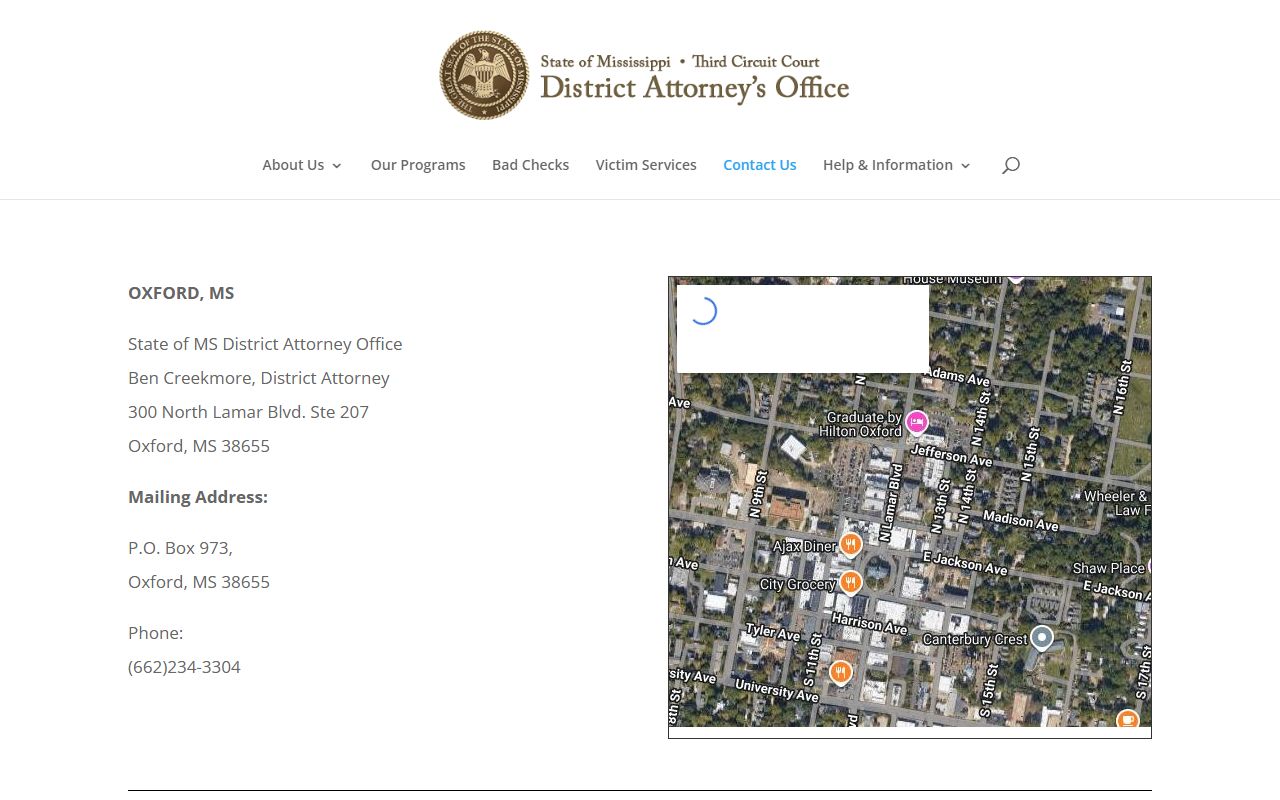
The contact page is the route to reach the office that prosecutes felony cases for the county.
Defendants who cannot afford a lawyer may receive appointed counsel. The Mississippi Office of State Public Defender maintains defender resources and a felony-level directory. Local felony defenders listed for Calhoun include Kevin L. Howe and Paul M. Moore Jr.

Appointed counsel can change as a case moves, so the court file is the place to confirm who represented a defendant.
Sealed vs. Expunged Records
Not every criminal record stays open forever. A court may seal a case, which hides it from public view but keeps it on file. Expunction goes further. Under Mississippi law, an expunged record is removed from public access and treated as if the offense never happened. The two outcomes look similar in a search, since both make a record vanish from public results, but they work in different ways.
| Sealed | Expunged | |
|---|---|---|
| Visibility | Hidden from public view | Removed and treated as never existed |
| Law Enforcement | Limited access remains | Very limited, narrow exceptions |
| Eligibility | By statute or court order on the case | Dismissals, acquittals, and certain convictions under Section 99-19-71 |
| How to Start | Court order in the case | Petition filed in the court that handled the case |
Expunction matters most for charges that were dismissed, dropped, ended in acquittal, or have no disposition. Some convictions carry waiting periods and exclusions. A person usually files the petition in the court that handled the case, which in Calhoun County may be Justice Court, Municipal Court, or Circuit Court. Local fees and forms were not found in official online sources, so calling the clerk for that court is the right first step.
Calhoun County Criminal Record Access
Mississippi treats court records as open unless a law, rule, or order closes them. The Public Records Act sets the default that records are available for inspection and copying. Court rules and privacy orders can still limit what a reader sees. The MEC Administrative Procedures add redaction duties for electronic files. A custodian may charge reasonable fees for search, copying, certification, and mailing, so it helps to ask the Circuit Clerk before paying.
Key Statutes:
Mississippi Code § 25-61-1 - States the policy that public records are open unless an exemption applies.
Mississippi Code § 99-19-71 - The main expunction statute for eligible Mississippi criminal records.
Mississippi Public Records Act - Lets the public inspect and copy records, with reasonable fees allowed.
Access still runs through the right custodian. Circuit Court criminal files go through the Circuit Clerk and the Third Circuit MEC or PAMEC system. A public-records request is a fallback, but it does not override sealed orders, juvenile confidentiality, or MEC privacy rules. Where the online path fails, the clerk counter and a written request are the next steps.
Federal Criminal Cases
Some Calhoun County conduct becomes a federal case, not a state one. The county sits in the U.S. District Court for the Northern District of Mississippi, Oxford Division. Federal criminal files are separate from Circuit Court records and are searched through PACER and the court's CM/ECF system. The Northern District of Mississippi site lists its courthouses and divisions.
One example shows the link. In March 2025, the U.S. Attorney's Office reported that a Calhoun County man was sentenced to 52 months for a role in the burglary of a federally licensed firearms store. That case ran in federal court because federal statutes applied. Federal prisoners appear in the Bureau of Prisons locator, not the county jail roster or the state MEC system.
Restricted Criminal Court Records in Calhoun County
Not all criminal records are open to the public. Mississippi law shields several types from a routine lookup. Youth Court records are confidential, and access is limited to parties, attorneys, court staff, agencies, or persons a court allows. Sealed and expunged cases may show limited detail or nothing at all. Records tied to active investigations, sealed warrants, or officer safety can be withheld for a time.
Personal identifiers are guarded even within open files. Public copies may mask Social Security numbers, birth dates, the names of minor children, financial account numbers, and home addresses. If a record involves an outstanding charge, the active warrant may sit with the sheriff or the issuing court rather than inside the case file. When a portal returns less than expected, that gap is often the law working as written, not a flaw in the search.
Note: If a Calhoun County criminal record is sealed or expunged, the clerk can confirm only what the law permits, so a blank result may be the correct and legal answer.