
What Is a Calhoun County Court Docket
A docket is a dated index of case events. Each line on it is a docket entry. That entry records one filing, one order, or one court setting. It shows the date, a short label for the action, and often the party who filed. Read in order, the entries tell the story of a case from the first paper to the last ruling. A docket does not hold the full text of every document. It points to those papers instead. Think of it as the table of contents for a case file.
The docket and the full case record are not the same thing. The docket lists events. The case file holds the actual motions, exhibits, and signed orders. A Calhoun County docket can show that a judgment was entered without showing the judgment itself. To open the document behind an entry, a reader may need court credentials, a clerk visit, or a copy fee. Circuit Court and Chancery Court each keep their own dockets, and the two courts use separate electronic systems.
Calhoun County sits in Pittsboro, the county seat. The courthouse serves Circuit Court, Chancery Court, and the offices that answer docket questions for the lower courts. Each court tracks its own calendar of settings and filings.
How to Find Calhoun County Dockets Online
There is no single county search box for every docket. The access point depends on the case type and the court. Circuit Court dockets live in the Third Circuit Mississippi Electronic Courts system. Chancery Court dockets live in the Eighteenth Chancery Mississippi Electronic Courts system. Both are known as MEC. The Eighteenth Chancery District also posts a public calendar of court settings. Justice Court and Municipal Court do not publish an online case search, so those dockets are reached by calling the clerk.
- Identify the court first. Felony cases, major civil suits, and appeals from lower courts point to Circuit Court. Divorce, custody, probate, guardianship, and land matters point to Chancery Court.
- For a Circuit case, open the Third Circuit MEC portal and sign in with MEC or PAMEC credentials. Public search fields beyond the login were not visible on the static page.
- For a Chancery case, open the Eighteenth Chancery MEC portal and sign in the same way. Divorce, probate, and equity files may include sealed or restricted entries.
- For scheduled chancery hearings, check the Eighteenth Chancery all-judges calendar, which is open to the public without a login.
- For Justice Court or city cases, call the clerk. The Justice Court Clerk answers at 662-412-3134, and the Calhoun City Municipal Court is reached through City Hall at 662-628-8345.
Older records may not appear in the electronic systems. MEC went live for Calhoun Circuit and Chancery Courts on March 20, 2023. For pre-2023 files, certified copies, or sealed matters, contact the Circuit Clerk or the Chancery Clerk directly.
Sample Calhoun County Docket Entry
A single docket entry packs several facts into one line. Once you know what each part means, the calendar becomes easy to scan. A free Calhoun sample case record was not visible from the public MEC login pages, so the fields below reflect standard MEC and docket practice rather than one observed Calhoun file. Each entry ties to a date, an action, and often a document the court has on file.
| Field | What It Shows |
|---|---|
| Entry Date | The date the clerk logged the filing or court action. |
| Event Type | A short label for the step, such as motion, order, or hearing notice. |
| Party Filing | The side that submitted the paper: plaintiff, defendant, petitioner, or respondent. |
| Document Name | The title of the pleading or order tied to that entry. |
| Document Link | A link to the filed document, which may be limited to attorneys of record. |
| Hearing Setting | The date, time, and assigned judge for a scheduled court event. |
Courts That Keep Dockets in Calhoun County
Mississippi runs several trial courts, and each keeps its own docket. Two of them publish through MEC, while the lower courts answer by phone. The court that opened a case is the court that holds its docket, so the access path follows the case type. The structure of Mississippi's trial courts decides where each calendar lives, and the state judiciary's trial-court overview lays out each level.
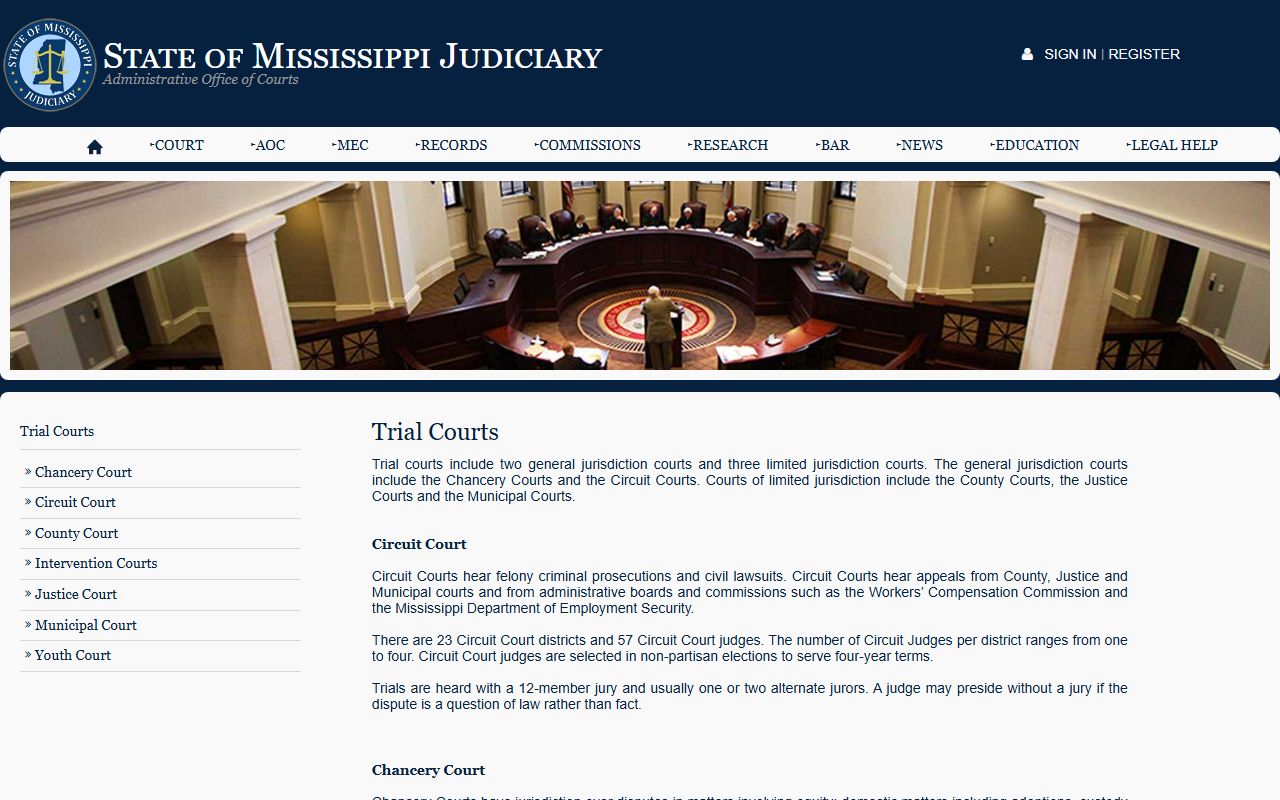
That overview confirms the split between Circuit, Chancery, Justice, and Municipal courts that shapes every Calhoun County docket search. The list below shows which court holds which dockets.
- Calhoun County Circuit Court handles felonies, major civil suits, and appeals from lower courts; its dockets run through the Third Circuit MEC system.
- Calhoun County Chancery Court handles divorce, probate, guardianship, conservatorship, and land-title cases; its dockets run through the Eighteenth Chancery MEC system and a public calendar.
- Calhoun County Justice Court handles small claims, county misdemeanors, and traffic outside city limits; its dockets are reached through the Justice Court Clerk.
- Calhoun City Municipal Court handles city tickets, ordinance cases, and municipal misdemeanors; its dockets are reached through City Hall.
- Youth Court records are confidential by law and are not a public docket search.
MEC Login and Registration for Dockets
Both Circuit and Chancery dockets sit behind a login. MEC is the filing side for attorneys, and PAMEC is the public-access side for registered users. There is no free anonymous case search visible from the login page. The login screen asks for a few fields and warns that the system is restricted to official court business, with every access attempt logged.
| Field Label | Type | Required | Notes |
|---|---|---|---|
| Login | text | Yes | MEC filer login or PAMEC public login. |
| Password | password | Yes | Credential for filing or viewing. |
| client code | text | Optional | 32-character field shown on the login screen. |
| Login | button | Yes | Submits the credentials. |
| Reset | button | No | Clears the fields. |
| Forgot Password? | link | No | Opens PAMEC password recovery. |
| Forgot Username? | link | No | Opens PAMEC username recovery. |
To register, follow the PAMEC sign-up path from the Mississippi Electronic Courts page and complete the account steps. Help comes from the MEC helpdesk at 601-576-4650 or helpdesk@mec.ms.gov. The current document-viewing fee should be confirmed during registration, since it was not posted on the public Calhoun pages.
Calhoun County Docket Terms Glossary
Docket entries lean on short legal terms. A reader who knows the words can follow a case without a lawyer. The definitions below cover the entries seen most often on Circuit and Chancery dockets in Calhoun County. They explain what the judge did, what a party asked for, or where the case now stands.
- Motion
- A written request asking the judge to take a specific action.
- Order
- The judge's written ruling on a motion or other matter.
- Continuance
- A postponement of a hearing or trial to a later date.
- Disposition
- The final or current outcome of a charge or a case.
- Judgment
- The final court decision, which may include a money award.
- Capias
- A writ directing an arrest, often after a failure to appear.
Docket vs. Full Case Record
A docket and a full case record serve different jobs. The docket is the list of events. The case record is the stack of actual papers behind those events. A Calhoun County docket can tell you that a motion was filed and ruled on, but only the case file shows the wording of the motion and the order. The broader set of filings, copies, and certified documents falls under the county's Calhoun County court records, which a clerk can pull or certify on request.
| Docket | Full Case Record | |
|---|---|---|
| Format | List of dated entries | Full filed documents |
| Contents | Event labels and dates | Motions, exhibits, orders |
| Access | Some online by MEC login or public calendar | May need credentials, a visit, or a copy fee |
| Best use | Track case progress and dates | Legal review and evidence |
Hearing Dates and Judge Assignments
Hearing dates show up on the docket as court settings. Each setting names the date, the time, and the judge assigned to hear it. In Calhoun County, Circuit Court cases are heard by the Third Circuit District judges, Grady F. Tollison III, Kent Smith, and J. Kelly Luther. Chancery cases are heard by the Eighteenth Chancery District judges, Larry Little and Robert Q. Whitwell. The judge tied to a setting controls the schedule for that hearing.
The Eighteenth Chancery District posts its settings on a public calendar, a rare open window into court scheduling. Its all-judges calendar lists court reporter details and courthouse locations across the district.
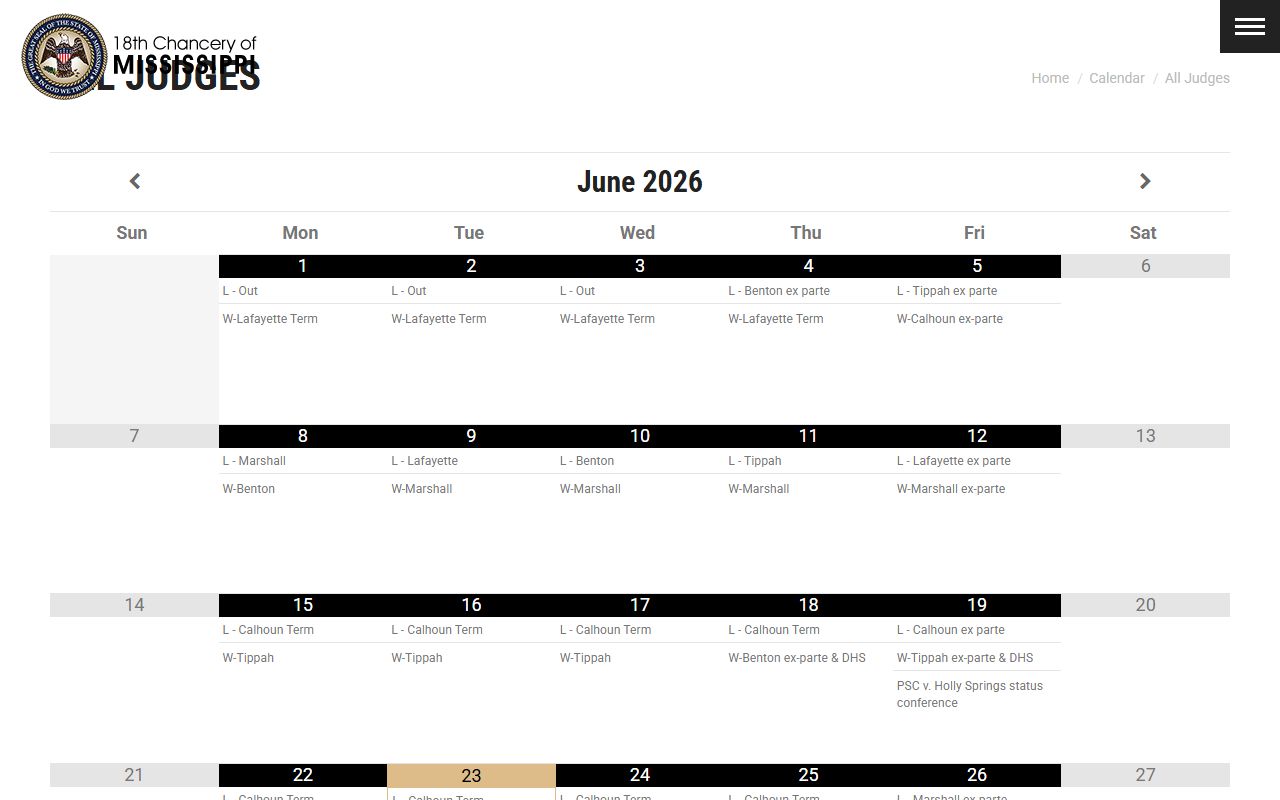
That calendar helps a party or witness confirm a chancery setting before traveling to the courthouse. For Circuit settings and for cases that route through the Calhoun County Circuit Court, the docket inside MEC remains the source for the next hearing date. Note: Hearing dates can move when a judge grants a continuance, so confirm a setting close to the date rather than relying on an older entry.
Restricted and Redacted Docket Entries
Not every docket entry is open to the public. MEC rules keep certain documents and details out of view, even when the entry itself appears on the list. A reader may see that a filing exists yet still hit a wall when trying to open it. The court rules that control filing and access spell out these limits, and the Mississippi Judiciary publishes them on its court rules page.
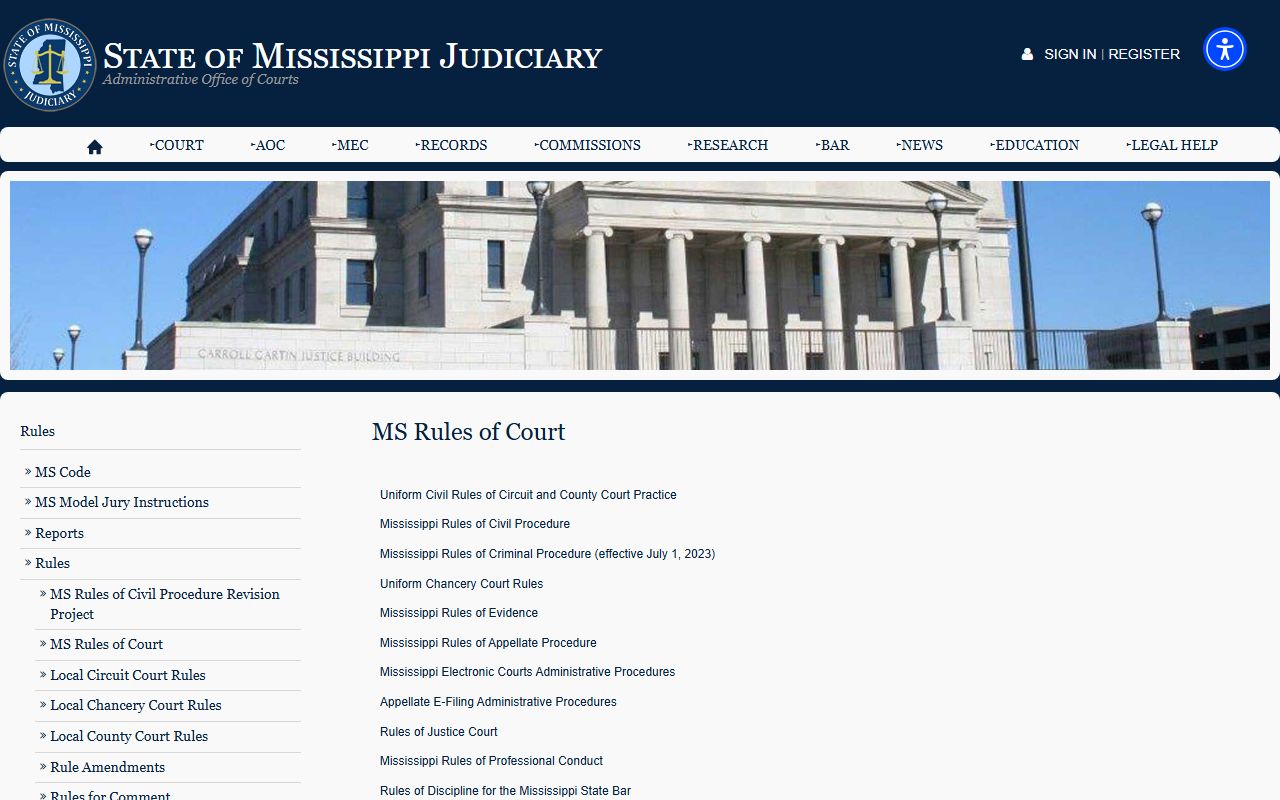
Those rules, set out in the MEC Administrative Procedures, drive the redaction and access limits described below. Some documents are restricted to the attorneys of record. If a link returns a message that you do not have permission to view the document, that filing is sealed from general access.
MEC privacy rules bar Social Security and taxpayer-identification numbers, dates of birth, names of minor children, financial account numbers, and home addresses from public filings except as the procedures allow. A docket may exist while these details stay masked or removed.
Whole categories of cases also carry tighter rules. Youth Court records are confidential. Adoption files, mental-health and capacity matters, and any case a judge has sealed may show limited information or none at all. When an entry is blocked, the clerk can confirm only what the law permits to be released.